IPTV Dolby Vision support is a genuinely practical question that goes beyond simply understanding what Dolby Vision is technically — it's about whether your specific setup, end to end, can actually deliver it. This guide focuses on that practical side: what needs to be true at every step for Dolby Vision to actually reach your screen, how to tell whether it's working, and why it's less common on live IPTV channels than you might expect from a premium TV's marketing.
For a deeper technical explanation of what Dolby Vision does differently from other HDR formats, see our Dolby Vision explained guide and HDR10 vs Dolby Vision comparison — this article assumes that background and focuses specifically on IPTV compatibility.
What IPTV Dolby Vision support actually requires
Dolby Vision only works end to end if every single link in the delivery chain supports it — a single unsupported link anywhere along the way means you won't see Dolby Vision, even if everything else is capable.
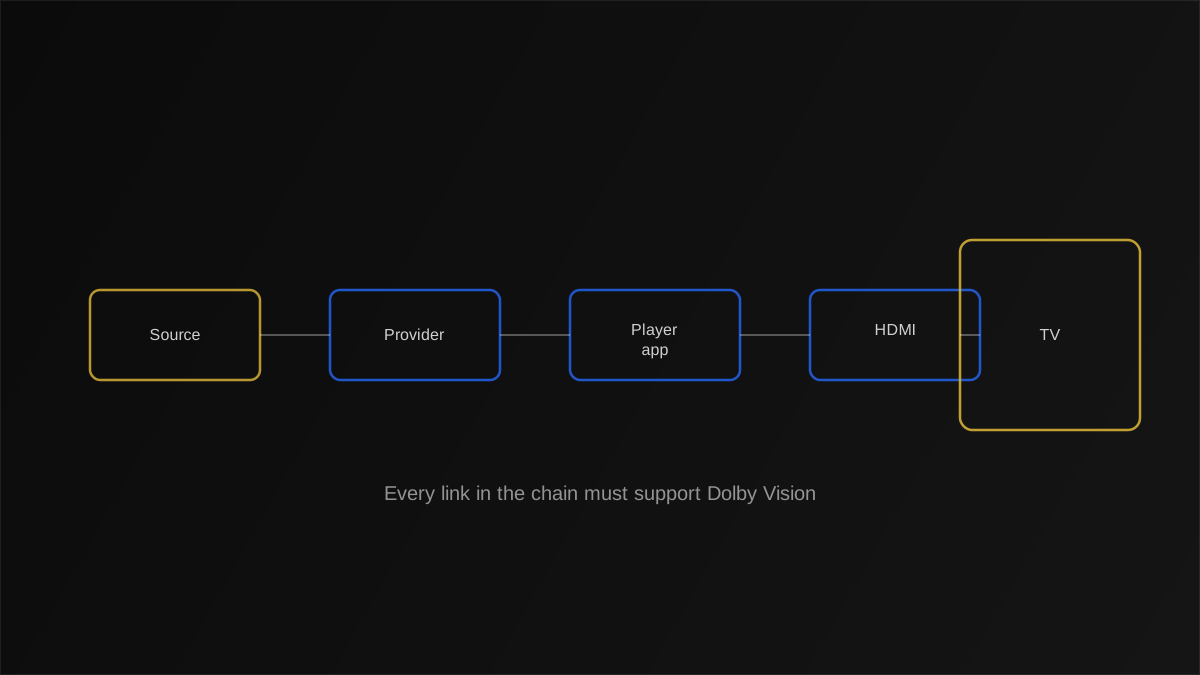
The source content itself
The channel or on-demand title must actually be mastered in Dolby Vision by the content creator. No amount of capable hardware downstream can add Dolby Vision to content that was never mastered with it in the first place.
Your IPTV provider's encoding pipeline
The provider's transcoding process must preserve the Dolby Vision metadata rather than stripping it during compression — some encoding pipelines, particularly those optimized for bandwidth efficiency across many channels, discard dynamic HDR metadata by default.
Your player app
The app decoding the stream must recognize and pass through Dolby Vision metadata to your device's video output, rather than treating it as standard HDR10 or ignoring the metadata entirely.
Your device and HDMI connection
Your streaming device or Smart TV's own hardware must support Dolby Vision decoding, and if using an external streaming box, the HDMI connection itself typically needs to be HDMI 2.0a or later — see our HDMI 2.1 guide for related bandwidth considerations relevant to HDR formats generally.
Tip
If any single link in this chain doesn't support Dolby Vision, most setups quietly fall back to standard HDR10 or SDR rather than failing outright — which is why "no error, just no Dolby Vision" is the most common symptom, not a crash or visible error message.
How to check each device in your setup for Dolby Vision support
Checking your streaming box or stick
Manufacturer specification pages typically list Dolby Vision explicitly, separate from generic "HDR" support — the two are not interchangeable, since a device can support standard HDR10 without supporting Dolby Vision's licensed format at all. If the spec sheet only mentions "HDR" without naming Dolby Vision specifically, treat that as an indication it isn't supported.
Checking your Smart TV
Most Dolby Vision-capable TVs display the Dolby Vision logo somewhere on their packaging, spec sheet, or settings menu. Within the TV's picture settings, a dedicated "Dolby Vision" picture mode option, distinct from a generic "HDR" mode, is a reliable sign of support.
Checking your player app
This is the least visible link in the chain, and often the most overlooked. Some apps explicitly document Dolby Vision passthrough support in their feature list or settings menu; others simply don't mention HDR handling at all, which is itself a useful, if indirect, signal that dedicated Dolby Vision support likely isn't a priority for that specific app.
Tip
When comparing player apps specifically for IPTV Dolby Vision support, look for explicit mention of "Dolby Vision passthrough" or "metadata passthrough" in the app's settings or documentation, rather than assuming general HDR support covers it.
Why Dolby Vision is less common on live IPTV channels specifically
Even with fully compatible hardware throughout your setup, IPTV Dolby Vision support depends heavily on content availability — and live channels are far less likely to be Dolby Vision mastered than premium on-demand movies and shows. Dolby Vision requires licensing fees and a certified mastering process that's easier to justify for a one-time movie release than for continuously-generated live broadcast content. Most live IPTV channels that support HDR at all default to standard HDR10, given its broader compatibility and lower barrier to implementation, as covered in our HDR10 vs HDR10+ comparison.
Note
Don't assume a "Dolby Vision" badge on your TV means every IPTV channel you watch is delivering it — the badge indicates your display's capability, not what any specific content is actually mastered in.
How to tell if IPTV Dolby Vision is actually active
- Check your TV's on-screen display indicator, usually shown briefly when playback starts or accessible through a picture-mode info overlay.
- Look for an automatic picture mode change — many TVs automatically switch to a "Dolby Vision" or "Cinema" picture mode specifically when Dolby Vision content is detected.
- Compare the same content across devices if available — a visible difference in picture handling between a Dolby Vision-capable device and one that isn't is a practical confirmation.
Pros and cons of prioritizing Dolby Vision for IPTV
| Consideration | Pros | Cons |
|---|---|---|
| For IPTV specifically | Excellent picture quality when the full chain supports it | Rarely available on live channels; requires every link to cooperate |
| For on-demand content | More commonly mastered, more consistent benefit | Still depends on your device and app supporting it fully |
Dolby Vision Profile 5 vs. Profile 8: why it can matter for IPTV
Dolby Vision isn't a single uniform format — it's implemented through several different technical "profiles," and two are worth knowing about specifically in a streaming context. Profile 8 is backward-compatible, meaning the stream also carries a standard HDR10 base layer alongside the Dolby Vision enhancement layer, so a device without Dolby Vision support still displays a correct HDR10 image rather than nothing at all. Profile 5, used more in some legacy contexts, lacks that HDR10 fallback layer, meaning a non-Dolby-Vision-capable device may not display HDR correctly at all when receiving Profile 5 content.
For IPTV specifically, this distinction matters because it affects what happens on non-Dolby-Vision devices watching the same content: Profile 8's fallback behavior is far more forgiving, which is part of why it has become the more common profile for streaming delivery generally, including whatever limited Dolby Vision content does appear on IPTV platforms.
Troubleshooting when IPTV Dolby Vision isn't working
Picture looks correct but no Dolby Vision indicator appears
This most often means the content itself isn't Dolby Vision mastered, or your provider's encoding pipeline stripped the metadata during transcoding — neither is fixable on your end.
Dolby Vision worked before but stopped
Check for a recent app or device firmware update that may have changed HDR handling, and confirm your HDMI cable and port haven't changed — see our HDMI guide for cable requirements.
Picture looks washed out or oddly colored
This can indicate a partial handshake failure — your TV detected Dolby Vision metadata but isn't correctly displaying it. Try toggling your TV's HDR settings off and back on, or switching HDMI ports.
Common mistake
Assuming a missing Dolby Vision indicator means something is broken. In most cases it simply means that specific piece of content wasn't mastered in Dolby Vision to begin with — a content availability issue, not a technical fault.
Bandwidth considerations for Dolby Vision on IPTV
Dolby Vision's additional dynamic metadata adds a small amount of overhead compared to standard HDR10, though the difference is modest relative to the overall stream bitrate. The more meaningful bandwidth consideration is that Dolby Vision content is typically paired with higher-quality 4K mastering, so the practical bandwidth requirement usually reflects the underlying 4K resolution more than the Dolby Vision metadata itself — see our 4K vs 1080p streaming quality guide for those baseline figures, and add modest headroom if Dolby Vision content is involved.
A connection that already struggles with standard 4K streaming will struggle equally, or slightly more, with Dolby Vision 4K content — the resolution and general bitrate demands dominate the bandwidth picture far more than the HDR format layered on top of it.
Real-world example: checking a new streaming box for Dolby Vision compatibility
- Confirm the streaming box's specification sheet explicitly lists Dolby Vision decoding support, not just general "HDR" support.
- Confirm your player app of choice supports passing through Dolby Vision metadata rather than converting everything to HDR10.
- Test with content you already know is Dolby Vision mastered, rather than a random live channel, to isolate whether the hardware chain works at all.
- Once confirmed working on known content, treat any live channel's lack of Dolby Vision as a content availability question, not a setup problem.
Semantic terms worth knowing
Terms like dynamic metadata, HDR, and transcoding are covered in our streaming terms glossary and full IPTV glossary, useful background for understanding this full compatibility chain.
Key takeaways
- IPTV Dolby Vision support requires every link in the chain — source, provider, app, device, and display — to support it simultaneously.
- Live IPTV channels are far less likely to be Dolby Vision mastered than premium on-demand content, regardless of your hardware's capability.
- A missing Dolby Vision indicator usually means content availability, not a broken setup.
- Compatible hardware falling back to HDR10 or SDR silently, without an error, is the expected, normal behavior when any link is missing.
Conclusion
IPTV Dolby Vision support comes down to a simple but strict rule: every step of the chain, from mastering through your display, has to cooperate. Understanding this makes it far easier to set realistic expectations — and to correctly diagnose a missing Dolby Vision indicator as a content question rather than assuming your hardware or subscription is somehow at fault.