4K vs 1080p streaming quality is a genuinely practical question, not just a spec-sheet comparison — the right answer depends on your screen, your seating distance, and, just as much, on whether your connection can sustain the higher bandwidth 4K actually requires. This guide compares both formats directly: what changes technically, what you'll actually notice, and when upgrading is worth it versus when a stable 1080p stream is the better real-world choice.
What actually changes between 4K and 1080p streaming quality
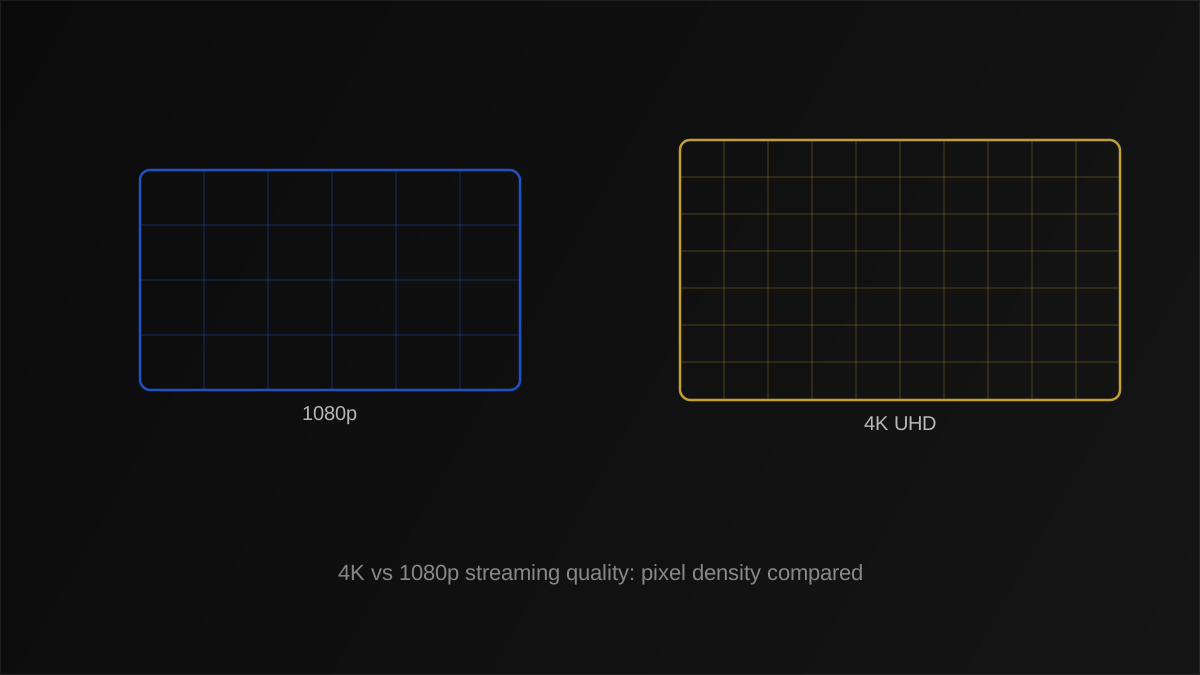
1080p (Full HD) is 1920×1080 pixels, roughly 2.1 million pixels total. 4K (Ultra HD) is 3840×2160, roughly 8.3 million pixels — almost exactly four times as many. More pixels means finer detail is possible, but whether you can actually perceive that extra detail depends on factors beyond the raw pixel count alone.
Screen size and viewing distance
Pixel density relative to your eye matters more than pixel count alone. On a 32-inch TV viewed from across a typical living room, the two formats can look nearly identical, since your eye can't resolve individual pixels at that density and distance anyway. On a 65-inch or larger screen, especially viewed up close, the extra detail in 4K becomes far easier to actually perceive.
Source mastering quality
A poorly encoded or heavily compressed 4K source can look worse than a well-encoded 1080p one. Resolution is only one input into perceived quality — see our streaming bitrate guide for how bitrate and resolution interact to determine what you actually see on screen.
4K vs 1080p streaming quality: bandwidth and internet speed requirements
This is where the comparison gets practical rather than theoretical. Higher resolution requires meaningfully more bandwidth to stream without compromise:
| Quality | Typical bitrate | Recommended connection speed |
|---|---|---|
| 1080p (HD) | 4-8 Mbps | 15+ Mbps |
| 4K (UHD) | 15-25+ Mbps | 25+ Mbps |
The gap between typical bitrate and recommended speed exists deliberately, giving your connection headroom to absorb normal fluctuation without dropping frames or buffering. See our internet speed for streaming guide for the full breakdown, including how multiple simultaneous devices multiply these figures.
Tip
Run a speed test at your normal viewing time before committing to 4K as your default — a connection that tests well at 2 PM can behave very differently during evening peak hours.
Pros and cons of 4K vs 1080p streaming quality
| Resolution | Pros | Cons |
|---|---|---|
| 4K | Sharper detail on large screens, future-proof | Higher bandwidth requirement, less forgiving of a weak connection |
| 1080p | More stable on modest connections, lower data use | Visibly softer detail on large, close-viewed screens |
When 4K streaming quality is genuinely worth prioritizing
- Screens 55 inches and larger, where extra pixel density is more perceptible.
- Close seating distances, common in smaller rooms with a large screen.
- Content originally mastered in 4K, rather than upscaled from a lower-resolution source.
- A connection that consistently, not just occasionally, sustains 25+ Mbps.
When 1080p is the smarter choice
- Smaller screens, under roughly 43 inches, where the difference is hard to perceive at all.
- Inconsistent or shared connections, where 4K's bandwidth demand risks frequent buffering.
- Multiple simultaneous streams in the same household, where 1080p leaves more bandwidth headroom for everyone.
Common mistake
Forcing 4K on a marginal connection. A stable 1080p stream consistently looks better in practice than a 4K stream that buffers or repeatedly drops quality mid-playback.
How video codec choice changes the real 4K vs 1080p streaming quality trade-off
The bitrate figures above assume a specific codec, and codec efficiency shifts the practical comparison meaningfully. Content encoded with the newer H.265 (HEVC) codec can deliver comparable 4K quality at a noticeably lower bitrate than the same content encoded with the older H.264 — see our H.264 vs H.265 comparison for the full breakdown. In practice, this means a provider using more efficient encoding can offer smoother 4K on a connection that would genuinely struggle with 4K encoded less efficiently, which is one reason two services both advertising "4K" can behave very differently on the exact same connection.
This also explains why bitrate figures in provider marketing should be read as a rough guide rather than an absolute rule — the underlying codec, not just the resolution label, has a real, measurable effect on how much bandwidth a given quality level actually needs in practice.
Stacking HDR on top of 4K: the combined bandwidth picture
4K and HDR are frequently bundled together in marketing, but they place separate, additive demands on your connection. HDR content typically carries additional metadata and, depending on the source, a somewhat higher bitrate than the same resolution without it, since preserving the wider brightness and color range HDR is built around benefits from more data to work with. A connection that comfortably handles standard 4K may need a bit more headroom for 4K content that also carries HDR10, HDR10+, or Dolby Vision — worth keeping in mind if a stream buffers specifically on HDR-flagged content while non-HDR content at the same resolution plays smoothly.
How upscaling affects perceived 4K vs 1080p streaming quality
Not everything labeled "4K" was actually filmed or mastered at that resolution — a significant amount of content is upscaled from a 1080p or lower source using algorithms that estimate the missing detail rather than genuinely capturing it. Upscaled 4K can still look noticeably better than native 1080p thanks to a good upscaling algorithm and your display's own processing, but it won't match true native 4K mastering. Your TV's own upscaling engine also plays a role: a high-quality display can make a native 1080p stream look sharper than the same content played on a weaker display's upscaler, which is worth keeping in mind when comparing quality across different devices rather than assuming resolution alone tells the whole story.
Note
Resolution and HDR are separate, independent factors — a 4K stream without HDR can look flatter than a well-mastered 1080p stream with HDR. See our HDR10 vs HDR10+ comparison for how dynamic range affects picture quality separately from pixel count.
Troubleshooting 4K streaming quality problems
4K stream keeps dropping to a lower quality
This is usually adaptive bitrate streaming responding to real-time network conditions rather than a fault — see our buffering troubleshooting checklist for the underlying causes.
4K content looks soft or blurry despite a fast connection
Check whether the source is actually native 4K or upscaled, and confirm your player app isn't defaulting to a lower quality tier manually — some apps cap quality unless changed in settings.
No noticeable difference after switching to 4K
Screen size and viewing distance are the most common explanation — see the screen size guidance above before assuming something is misconfigured.
How your device affects 4K vs 1080p streaming quality
The comparison isn't purely about your connection and screen — your streaming device's own hardware plays a real role too. Decoding 4K, especially with newer codecs like H.265 or AV1, demands more processing power than decoding 1080p. Older streaming boxes and budget Smart TVs sometimes lack dedicated hardware decoding for these formats, forcing slower software-based decoding that can cause stuttering even when your network connection is entirely capable of delivering the stream smoothly. If 4K playback stutters specifically while 1080p on the same connection and app plays perfectly, an underpowered device — not your bandwidth — is the more likely explanation.
This is a genuinely useful diagnostic distinction: a bandwidth problem tends to show up as buffering or automatic quality drops, while a device decoding problem tends to show up as stuttering or dropped frames despite the stream itself loading without interruption. Testing the same 4K channel on a different, more capable device is the fastest way to tell the two apart.
Real-world example: choosing quality for a shared household connection
- A household with a 100 Mbps connection has three people streaming simultaneously on different devices.
- Two viewers on 1080p uses roughly 8-16 Mbps combined, leaving comfortable headroom.
- Adding a third viewer on 4K adds another 15-25+ Mbps, pushing total usage closer to the connection's real-world ceiling once overhead and fluctuation are factored in.
- Enabling QoS, covered in our router settings guide, helps prioritize traffic if buffering appears during peak simultaneous use.
This kind of simple bandwidth math, done before committing to 4K by default on every device, prevents a frustrating trial-and-error process later.
Beyond 4K: is 8K relevant yet?
8K streaming exists but remains a niche consideration for most viewers today — see our 8K streaming guide for where it currently stands. For the vast majority of households, the meaningful practical decision remains squarely between 1080p and 4K, not 4K and 8K.
Semantic terms worth knowing
Terms like bitrate, upscaling, and adaptive bitrate streaming are covered in our streaming terms glossary and full IPTV glossary, useful companions when comparing quality tiers. For the formal technical specifications behind these resolution standards, the Wikipedia entry on 4K resolution and 1080p reference provide the official pixel-dimension definitions.
Key takeaways
- 4K has roughly four times the pixel count of 1080p, but the difference is only clearly visible on larger screens or at closer viewing distances.
- 4K streaming needs meaningfully more bandwidth — plan for 25+ Mbps sustained, not just peak, speed.
- A stable 1080p stream generally looks better than a 4K stream that buffers or drops quality repeatedly.
- Resolution and HDR are independent factors — both affect perceived picture quality separately.
Conclusion
4K vs 1080p streaming quality isn't a question with one universal answer — it depends on your screen size, seating distance, and, critically, whether your connection can sustain the higher bandwidth consistently rather than just at its peak advertised speed. Check what quality tiers are included on our pricing page, and use the bandwidth guidance above to choose the option that will actually play smoothly in your specific setup, rather than defaulting to the higher number on principle alone.